
How ShellHub Improves Security in Remote Access with RBAC

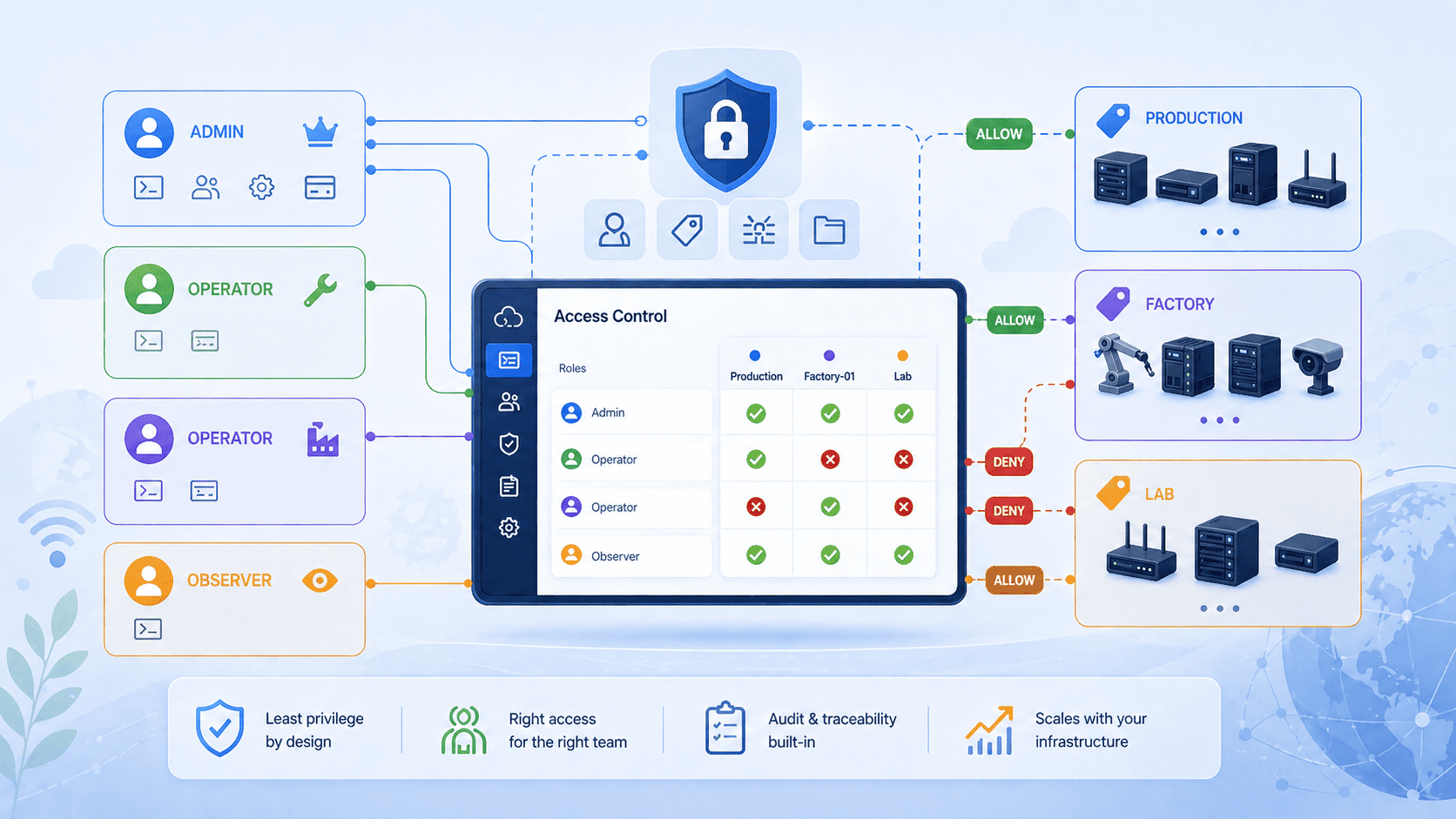
In enterprise environments, multi-user access is a requirement. As organizations scale their fleets of connected devices, remote access must evolve from an operational task into a structured, secure, and efficient part of the infrastructure.
The challenge is clear: how do you provide access to the right people, at the right time, with the right level of control, without slowing down your team?
This is where Role-Based Access Control (RBAC) in ShellHub becomes a game-changer.
Why Access Control Defines Enterprise-Grade Remote Access
Modern IoT, embedded systems, or virtual machines demand more than simple SSH connectivity. They require:
- Granular permission management
- Auditability and traceability
- Scalability across teams and devices
- Security by design
ShellHub was built with these principles in mind, delivering centralized access control, auditing, and device management for distributed infrastructures.
But the real power comes when access control is no longer manual and becomes systematic.
How does ShellHub make this possible?
ShellHub’s Roles allow organizations to define who can do what within a namespace.
Instead of assigning permissions individually (which doesn’t scale), you:
- Define roles (e.g., Admin, Operator, Observer)
- Assign permissions to roles
- Attach users to those roles
This abstraction simplifies management and ensures consistency across your organization.
Example
- Owner → Full control over the namespace and billing
- Admin → Full access (devices, users, settings) except billing
- Operator → Can perform core operations on devices but has limited privileges
- Observer → Only connect to devices and view details about them, but cannot modify anything.
With Roles combined with other features, onboarding a new team member becomes trivial: assign a role, and they instantly inherit the correct permissions.
Beyond Control: Combining Roles with ShellHub Features
Roles alone are powerful, but their real value emerges when combined with other ShellHub capabilities.
1. Device Tagging: Context-Aware Access
Device tagging allows you to group devices based on:
- Environment (production, staging)
- Location (office, factory, remote)
- Role (database, backup, web-server)
Combined with Roles:
You can restrict access so that:
- A support engineer only accesses staging devices
- A regional team only manages devices in its geography
Result: Less risk, more clarity
2. Firewall Rules: Enforcing Security Boundaries
ShellHub includes firewall rules that define how and when devices can be accessed.
Combined with Roles:
- Even if a user has permission, firewall rules can limit access paths
- You enforce network-level policies aligned with organizational roles
Result: Defense in depth
3. Namespaces: Isolating Teams and Projects
Namespaces act as logical environments for devices, users, and configurations.
Combined with Roles:
- Different teams operate independently
- Roles are scoped per namespace
- No accidental cross-project access
Result: Organized and scalable operations
From Task to Infrastructure: A Shift in Mindset
Without structured access control, remote access becomes:
- A manual process
- A security risk
- A bottleneck for teams
With ShellHub, it becomes:
- Predictable → Roles define behavior
- Automated → No manual permission handling
- Secure → Least-privilege enforced
- Scalable → Works across thousands of devices
This aligns with how modern infrastructure should behave: declarative, controlled, and integrated into workflows.
Built on Experience and Expertise
ShellHub is not an isolated tool. It's the result of over two decades of experience in embedded systems and open-source development.
O.S. Systems has been delivering secure, scalable solutions for embedded Linux and IoT since 2002, actively contributing to the Open-Source Community and supporting global clients with robust infrastructure and tooling.
This background is reflected in ShellHub’s design:
- Security-first architecture
- Developer-friendly workflows
- Enterprise-ready scalability
Practical Impact: What Teams Gain
By implementing ShellHub alongside their ecosystem, teams achieve:
- Faster onboarding of engineers
- Reduced operational overhead
- Improved compliance and auditing
- Stronger security posture
- Seamless collaboration across teams
Most importantly, remote access stops being a recurring task and becomes part of the system itself.
Conclusion
Enterprise environments demand more than connectivity. They require control, structure, and trust.
ShellHub transforms remote access into a core infrastructure component rather than an operational burden.
If your team is still managing access manually, you're losing time and introducing risk to your operation.
Ready to modernize your remote access strategy?
- Request your free trial of ShellHub Enterprise
- Talk to our embedded systems specialist
- Explore how ShellHub fits your infrastructure
Make remote access scalable, secure, and effortless.