
Why Product Teams Should Design Remote Support From the Start

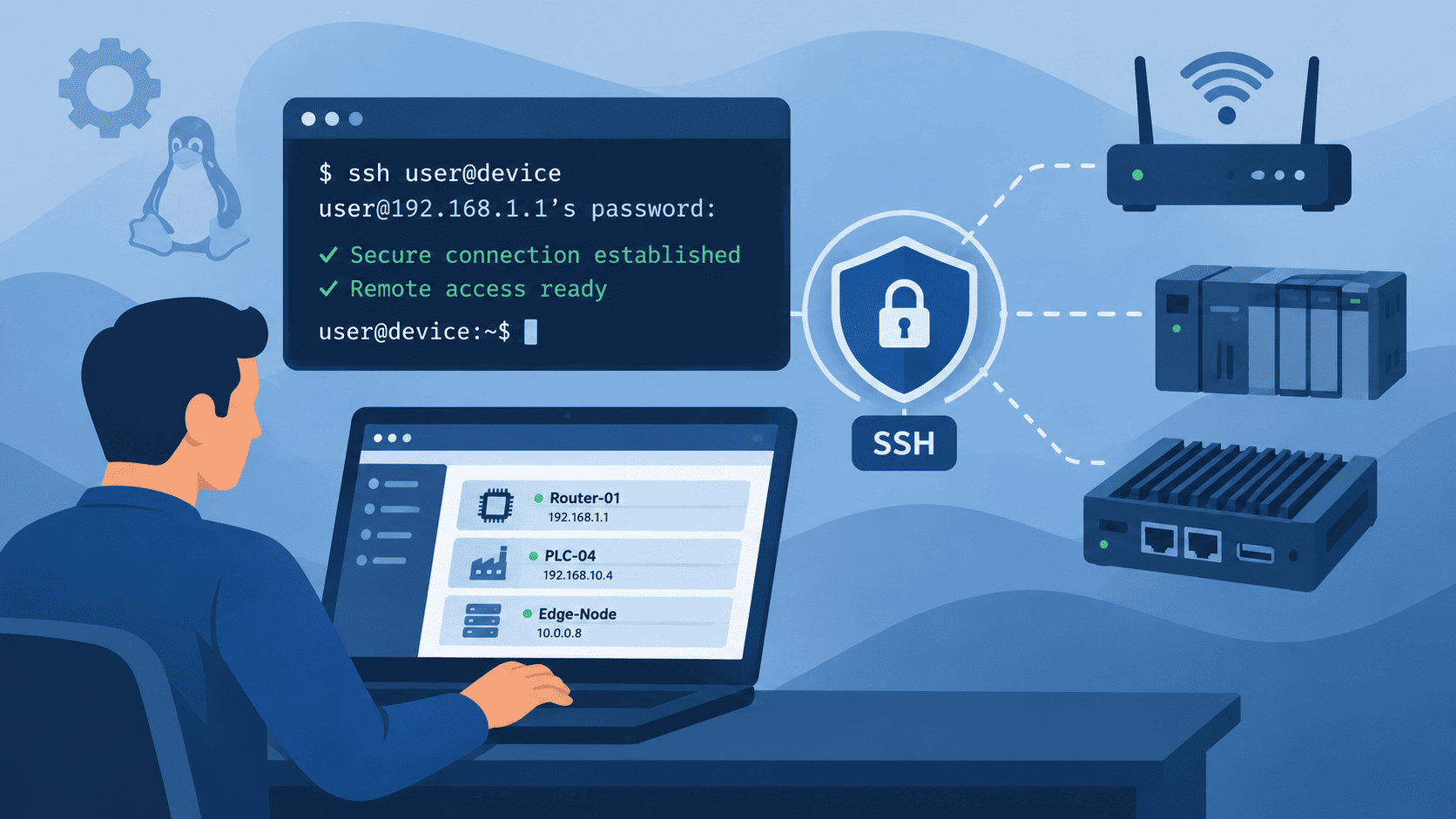
Remote support is not a service-desk add-on. For connected Linux products, it is a lifecycle capability that shapes architecture, security, and customer experience.
A connected product does not stop becoming a product when it leaves the factory, the lab, or the integration environment. It enters a much less controlled reality: varying networks, field configurations, operational policies, hardware conditions, and people who need answers quickly but may not have the right access to investigate.
That is why remote support should be a product-design question, not a late-stage support tooling decision.
Teams often discover the need only after the first difficult incident. A device is online but unreachable. A customer reports behavior that cannot be reproduced in the lab. A specialist needs to inspect logs, configuration, or a running process, but access depends on someone at the site, an improvised network exception, or a credential that was never meant to be shared. What looked like a support problem is usually a design gap that has reached production.
The strategic question is not simply, “How will we log in remotely?” It is: how will the product be safely serviceable throughout its operating life?
For product leaders, that question connects reliability, security, support capacity, customer trust, and the long-term cost of owning the product.
Supportability is part of the product, not an afterthought
A physical product has long been judged by its serviceability. Can a technician inspect it, diagnose a fault, replace a component, and restore operation without unnecessary disruption?
Connected products need an equivalent digital discipline.
A device can be well designed for its initial deployment and still be difficult to operate after deployment. It may boot reliably, pass factory tests, and meet its core functional requirements. Yet if the team cannot establish the product’s current state, investigate an incident with appropriate context, or provide controlled expert access when it is needed, support becomes dependent on physical presence and informal workarounds.
This is especially important for embedded Linux products, gateways, industrial equipment, kiosks, network appliances, and distributed edge systems. Their location may be remote, protected by a customer network, behind NAT or firewall boundaries, or simply unavailable at the exact moment an expert needs to inspect them.
The result is not always a truck roll. Physical service can be necessary, valuable, and sometimes the only responsible option. The point is different: a team should be able to distinguish work that genuinely requires someone on site from work that is remote diagnosis, controlled investigation, configuration review, or expert guidance. Without that distinction, every access problem is treated as a field-service problem.
Designing for remote support creates options. It does not eliminate the need for hands-on service.
The cost of leaving the decision late
When remote support is treated as something to solve after launch, the team is usually forced to make choices under pressure. Those choices tend to optimize for immediate access rather than for a durable operating model.
That can produce familiar patterns:
- a device exposes an interface that was never designed for long-term external access;
- a technician needs a customer or local operator to be available before an investigation can begin;
- access is granted too broadly because the team has no practical way to scope it;
- shared credentials or one-off exceptions become the path of least resistance;
- incident context is spread across tickets, chat messages, local notes, and personal knowledge;
- the same investigation is repeated because the team cannot reliably review what was done before.
None of these outcomes necessarily comes from poor engineering. They are often the predictable consequence of a product organization treating serviceability as a downstream responsibility.
The late-stage cost is not limited to support. Product, security, engineering, and customer-facing teams all inherit the consequences:
- Engineering loses time reconstructing field conditions instead of improving the product.
- Security inherits an access path without a clear threat model, ownership model, or audit expectation.
- Support becomes a coordination function between people who hold fragments of the required context.
- Product management has less reliable evidence about which failures are isolated, recurring, environmental, or design-related.
- Customers experience delay and uncertainty during the moments when they most need confidence in the product.
A remote-support design decision made early does not guarantee easy operations. It gives the organization a system for approaching operational problems deliberately instead of improvising every time.
Remote support is a system of decisions
A useful way to approach the topic is to avoid viewing remote access as a single feature. It is a system of connected decisions.
1. What information is needed before privileged access?
Remote shell access can be essential for diagnosis, but it should not be the first and only form of visibility. Teams need to decide what operational context is available before someone starts an interactive session.
That may include device identity, software version, connectivity state, relevant logs, configuration status, and the history of prior interventions. The exact telemetry model will vary by product and risk profile. The important point is that an expert should not have to begin every investigation by asking, “Which unit is this, what is it running, and what changed?”
This is not a call to collect every possible data point. More data can create privacy, storage, security, and interpretation problems of its own. It is a call to define the minimum useful diagnostic context for the product’s actual support scenarios.
2. Who needs access, to which device, under which conditions?
Support access is rarely a binary choice between “full access” and “no access.” Product organizations commonly involve different roles: internal support, SRE or platform engineers, embedded specialists, integration partners, authorized service providers, and, in some cases, customer administrators.
Their responsibilities are different, so their access should not all look the same.
A sound design review asks:
- Which roles need to investigate an incident?
- Is access scoped by customer, product line, environment, or device group?
- Can access be granted and removed without changing the device manually?
- Which local accounts and privileges are appropriate for each task?
- What additional approval or presence is required for higher-risk actions?
This is where remote support becomes a product and governance decision rather than an SSH configuration exercise. The goal is not to make access difficult. The goal is to make legitimate access routine, bounded, and explainable.
3. How does connectivity work in the environments the product will actually face?
A design that assumes direct reachability can fail the moment the device sits on a customer network, behind NAT, or inside an environment where inbound connectivity is not acceptable.
Product teams should map the expected deployment conditions early:
- Will the device reliably make an outbound connection?
- What network destinations, protocols, certificates, or proxies must be supported?
- What happens if connectivity is intermittent?
- What behavior is acceptable if the remote-support service is unavailable?
- How is remote access disabled, restricted, or recovered when the product changes ownership or leaves service?
These are architecture questions because they influence the product’s network behavior, deployment requirements, documentation, and incident procedures. They should be reviewed alongside provisioning, update strategy, observability, and identity, not after all of them are fixed.
4. What evidence remains after the session ends?
A support action can resolve an incident and still leave an operational blind spot if the organization cannot answer basic questions later: Who accessed the device? When? What was the scope of the intervention? What should the next engineer know?
The appropriate level of logging and recording depends on the product, customer commitments, privacy constraints, and regulatory environment. But the decision should be explicit.
Auditability is not only about compliance. It improves continuity of care. It helps teams hand an incident from one person to another, review a change during a post-incident analysis, and identify whether a recurring problem has a common pattern. It also makes it easier to distinguish an authorized intervention from an unexplained change.
5. What must never be possible remotely?
The most mature remote-support designs do not start by maximizing capability. They define boundaries.
Some products have safety, regulatory, contractual, or operational conditions that make certain actions inappropriate without local confirmation, a maintenance window, a second approver, or a physical presence. Other actions may require a separate controlled workflow rather than an ad hoc terminal session.
This is not a limitation of remote support. It is part of responsible product design. A remote-access capability should make the permitted actions clearer, not blur the line between diagnosis, maintenance, configuration, and high-impact change.
Bring support, security, and product together before the architecture hardens
The strongest outcome comes from treating remote support as a cross-functional design topic early in the development cycle.
Product management can define the service promise. What level of diagnosis or response should be possible after deployment? Which users or operating environments matter most? What is the escalation path when remote investigation is not sufficient?
Engineering can translate those requirements into device behavior, identity, networking, permissions, logging, and recovery mechanisms.
Security can help model threats and define controls around authentication, authorization, credential lifecycle, network exposure, and audit evidence. NIST’s guidance on remote access emphasizes securing remote-access components against threats identified through threat modeling. CISA’s Secure by Design approach likewise asks technology manufacturers to take ownership of customer security outcomes instead of treating security as a burden transferred entirely to the customer.
Support and field teams can contribute the scenarios that architecture reviews often miss: the intermittent issue, the configuration difference, the device that is online but not behaving as expected, the customer environment where an inbound connection is not feasible, and the investigation that needs a specialist who is not physically present.
The earlier these perspectives meet, the more likely the result is a support model that fits the product rather than a patch applied around it.
A practical design review for product teams
Before a connected product reaches broad deployment, ask the following questions together:
- Support scenarios: What are the most likely incidents that require expert investigation after deployment?
- Diagnostic context: What information should be available before an interactive session begins?
- Connectivity model: How will devices communicate from the networks they will actually use, including restricted or NATed networks?
- Identity and authorization: Which people, systems, and roles can request access, and how is that access scoped and revoked?
- Privilege boundaries: What can each role do? Which actions require additional controls or cannot be done remotely?
- Evidence: What access and intervention history must be retained, who can review it, and for how long?
- Lifecycle: How are credentials, certificates, agents, and policies maintained, rotated, updated, or removed?
- Failure modes: What happens when the device is offline, partially functional, isolated from the remote-support service, or in a state that requires local recovery?
- Customer control: What does the customer need to understand, approve, configure, or audit about remote support?
- Ownership: Which team owns the remote-support capability after the product launches?
The answers will differ across industries and products. That is expected. A secure service model for a lab instrument, a telecom gateway, and an industrial controller should not be identical. What should be consistent is the decision process: product teams should make the choices intentionally, document them, and revisit them as the product and its deployment model evolve.
Where ShellHub fits
For Linux-based devices, ShellHub can provide an implementation path for governed remote shell access. Its public documentation describes a lightweight agent installed on devices, servers, or containers that establishes a secure connection to the ShellHub server. The agent uses a persistent secure WebSocket connection and a reverse tunnel, avoiding the need to expose devices directly to the internet or configure complex inbound routing.
That connectivity model matters, but it is only one part of the design. ShellHub documentation also describes public-key authentication, SSH firewall rules, namespace-based resource organization with roles and permissions, and audit logging. In ShellHub Cloud and Enterprise, session recording is documented as available for interactive SSH sessions.
These capabilities can help teams operationalize a remote-support model. They do not replace the product decisions described above. A product team still needs to define its access boundaries, support procedures, lifecycle responsibilities, customer commitments, and rules for high-impact actions.
That is the right order of thinking: start with the operating model, then choose the infrastructure that helps enforce it.
The strategic shift
The phrase “remote support” can sound like a narrow service concern. In practice, it is a product-lifecycle capability.
When teams design it early, they can make deliberate choices about how experts reach devices, how access is governed, what evidence is retained, and where remote intervention must stop. They give engineering better field feedback, give support a more reliable path to investigation, and give customers a clearer understanding of how their deployed systems are handled.
When they postpone it, they often turn predictable operating needs into urgent exceptions.
The question for product teams is not whether every issue can be solved remotely. It is whether the product has been designed so that the issues that can be understood, diagnosed, and safely addressed remotely do not depend on an improvised path to access.
That is not an add-on for after launch. It is part of designing a connected product that can be responsibly operated for years.